Clinical visits alone aren’t enough to support healthy habits and mental well-being.
Children thrive when support continues at home, in schools, and in their communities.
At Sanford Children’s Hospital, clinicians wanted to support whole-child wellness during routine visits, not just address immediate medical needs.
So Sanford fit was created in 2010 to extend providers’ expertise far beyond the exam room. The program operates as a bridge between appointments and everyday life by providing free, evidence-based resources for children, caregivers, educators, and health care providers.
“We’re closing that gap between patients and providers by giving them a way to engage with experts outside of the clinical space,” said Brittney Nathan, CCLS, lead program development specialist. “It’s important for us to provide parents and caregivers with advice and resources they can rely on.”
Rooted in time and access
Like many pediatric providers, Sanford Children’s clinicians faced increasing demand during short visits. Providers want to talk with families about picky eating, movement, sleep, and anxiety, but appointment constraints made it difficult to go beyond immediate clinical concerns.
“We heard a need and desire from providers to be able to talk about these topics and give patients and families more,” Nathan said. “This is an extension of that education they were struggling to provide.”
After the pandemic, those pressures intensified. Physicians saw declines in well-child visit compliance and growing mental health needs among children and adolescents. At the same time, families were seeking guidance in an environment saturated with misinformation.
The changing landscape prompted Sanford fit to broaden its approach. The team expanded resources focused on mental and behavioral health, developed new content for teens and caregivers, and increased efforts to have closer connections with providers.
“When we’re looking at treating the whole child, that spectrum expands outside of the space where our providers are,” Nathan said. “We found an opportunity to support families in a way that evolves to real change greater than various appointments here to there.”
Designing the education
Sanford fit translates clinical expertise into resources families can use independently.
Free printables, workbooks, articles, videos, and interactive activities are available online for anyone invested in kids, including educators, parents, and caregivers.
“It’s important to look at our impact and think about how we can provide education that creates practical change at home,” Nathan said.
The program focuses its resources around four pillars:
- Mood: Helps children identify feelings, understand how emotions influence behavior, and practice strategies to manage them.
- Food: Explores how food fuels the body and supports healthier nutrition choices.
- Recharge: Focuses on sleep, rest, and screen use to help kids and families build routines that support overall well-being.
- Move: Promotes physical activity as part of daily life and shows how movement can take many forms beyond structured exercise.
Every topic area is developed in collaboration with subject matter experts inside the hospital system, including child life specialists, pediatric psychiatrists, psychologists, pediatricians, and nutrition professionals. The content is designed to align with developmental stages from preschool through adolescence and has options for different learning styles.
The program also draws from Sanford Children’s community health needs assessment to prioritize topics, along with feedback from educators, parents, and clinicians.
Embedding into care settings
Sanford fit has integrated physical and digital education into care environments.
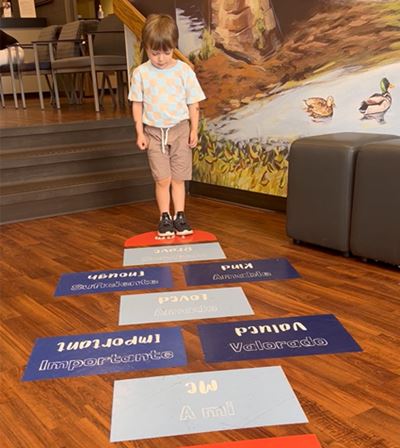
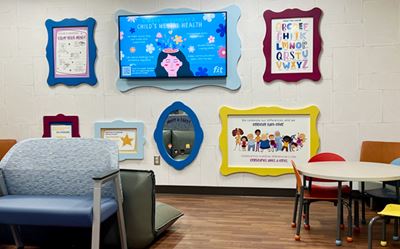
Over the past three years, efforts have expanded beyond online resources into clinical spaces with redesigned waiting rooms intended to support both kids and caregivers.
“The medical environment can be a scary and unpredictable place for kids,” Nathan said. “We’re stepping into this space to help them manage their fears today and develop lasting coping skills for the future.”
Wall displays double as coping tools for breathing exercises, grounding, and emotion identification. Digital screens show curated content focused on healthy habits and seasonal safety tips.
The elements use waiting time to introduce concepts and reinforce skills without adding to provider workload.
Measuring reach
Sanford fit tracks utilization across digital and in-person touchpoints to understand how families are engaging with resources.
In 2025, the team reached more than 15,000 children through 30 events, while continuing to expand its online presence.
Digital engagement represents a large portion of the program’s reach:
- 202,700 individuals accessing content online
- 16,400 resource downloads
- 30,000 email subscribers
- 5.5 million views on social media
Philanthropic funding allows Sanford fit to distribute resources at no cost, including printed mental health workbooks sent directly to clinics for providers to share with families.
Treating education as infrastructure
Sanford fit treats education not as an add-on, but as part of how care is delivered before, during, and after a visit.
Nathan said program replication doesn’t require identical funding or scale. It’s approaching wellness education as core infrastructure.
“It comes down to a shift in how we view our role,” Nathan said. “Once you commit to supporting the whole child, you realize the impact of that care can’t be contained within a clinic building.”