In just six months, four patients required critical care for vitamin K deficiency bleeding.
Inova L.J. Murphy Children’s Hospital recognized the need to act.
The infants were admitted to the PICU with potentially life-changing complications — an unusually high number for a preventable condition.
At the same time, clinicians across the system were seeing a steady rise in parental refusal of the vitamin K injection at birth. Over three years, the refusal rate of vitamin K injection for newborns doubled from 5.00 to 10.04 per 1,000 discharged alive.
“It made us question whether our system had the best approach to vitamin K,” said Allison Barberio, senior director at Inova Children’s.
Leaders designed a process to standardize when and how conversations happened with families and ensure they were led by clinicians best positioned to start them.
Within a year, refusal rates dropped by nearly 18%. And even more importantly, care teams aligned on a consistent intervention to build trust with families at a time when skepticism toward newborn care is increasing nationwide.
Variation in practices
When pediatric leaders analyzed the current state, they found a fragmented approach across delivery sites within the system.
There was variation in how families received information and who spoke with them.
“We recognized we could do a better job at providing clear and consistent evidence to families,” Barberio said. “And it was important to identify who was the best person to have that conversation due to the potential severe impacts to the child.”
The shift to physician-led conversations
Leaders focused on a core question: Who is best positioned to have conversations with families unsure about the vitamin K injection?
The hospital established a standard pathway across all care sites for physicians and advanced practice providers to lead discussions about benefits and risks and answer questions.
An elevated process was triggered during triage when families indicated their intentions to refuse the injection and was supported by a coordinated care response.
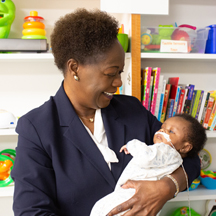
When a family expresses hesitancy, the care team is notified. Nurses prepare families for the discussion. Then, a nursery hospitalist or neonatologist meets with them at the bedside.
The approach signals both clinical expertise and urgency. Families responded differently when they saw a physician step in specifically to address their concerns.
“There is a deeper meaning when a family sees we are pulling in a physician or advanced practice provider to have this conversation about how strongly we feel this is important, and they should know the risks before they make a decision,” Barberio said.
Bringing physicians and advanced practice providers into these conversations required defined workflows, but not persuasion.
“Our doctors were already invested because they had seen the outcomes,” said Cynthia Gibson, MD, chair of the department of pediatrics. “They’re the ones who work in the newborn nursery all the time and understand very clearly what the risks are with these babies.”
The team also developed a standardized refusal form in partnership with risk management that clearly states associated risks of refusing the injection and requires both provider and parent signatures.
“It made it very evident what risks they were accepting for their baby,” Gibson said.
But standardizing the bedside conversation was only part of the improvements.
Starting earlier
Leaders expanded the work upstream.
They introduced a third-trimester checklist at 28-week appointments, giving OB-GYNs a structured way to talk about vitamin K and direct families to reliable information.
Families with significant concerns were offered optional prenatal consultations with pediatric hematology/oncology experts. Some families used these consults, but they were less effective than real-time conversations after birth.
“The upstream approach plants the seed, but the bedside conversations with a provider is where we saw the biggest impact,” Barberio said.
Education beyond the hospital
Because parents arrived with a wide range of education depending on where they received prenatal care, Inova Children’s also engaged pediatricians, birthing centers, and midwives in the community.
“There are so many places where delivering mothers are coming from, so whether or not they’ve had education on vitamin K is tricky to track down,” said Sarah Smith, DPT, director of quality. “We saw everything from not talking about vitamin K at all to being very structured.”
This outreach also revealed how much families’ decisions were being influenced before they spoke with an expert.
Information from social media also played a significant role. Many parents were getting misinformation from platforms like TikTok.
“There are subcommunities on social media, and if you aren’t aware of those, you can miss a huge aspect of what’s shaping how families think about care,” Smith said.
The health system expanded its educational approach beyond clinical visits. Leaders collaborated with the hospital’s communications department to share vitamin K information on their digital and social channels.
The goal was to meet families where they are with evidence-based messages.
The value of the work
The initial improvement period from February 2024 to January 2025 resulted in a 17.8% drop in vitamin K refusal rates.
Since then, the system has noted a rise in the refusal rate after the initial decline, but not back to levels at the beginning of this work.
Barberio said that does not diminish the value and effectiveness of their efforts.
The process is more consistent. Conversations are documented, and families receive clear, expert guidance along their care continuum.
The approach has led to meaningful outcomes. One family that initially declined the injection after birth ultimately chose to return for it after follow-up conversations with a pediatric specialist.
Deferring to expertise
Rising skepticism around newborn care is not something children’s hospitals can eliminate. But Inova Children’s focused on how to engage families and protect newborns from vitamin K deficiency bleeding.
“We know that information families encounter in their everyday lives is not always aligned with clinical evidence,” Barberio said. “We are continually working to refine our approach to conversations based on how the information presented to families is changing.”
And in an environment shaped by fragmented information and growing distrust, the most effective method is consistency: when the conversations happen, who they are with, and how clearly the message is delivered.
This work was presented on the “Vitamin Knowledge: Reducing Vitamin K Refusals for Newborns” poster at the Children’s Hospital Association’s 2025 pediatric quality conference.