Twenty years ago, the partnership between Mt. Washington Pediatric Hospital, the University of Maryland Medical System, and Johns Hopkins Medicine put into writing what had always been understood: The most complex pediatric patients deserve a continuum of care no single hospital can provide on its own.
For children born with significant breathing or feeding challenges or who have had a stroke, a cancer diagnosis, or a traumatic accident, care begins at University of Maryland Golisano Children’s Hospital and Johns Hopkins Children’s Center.
Their acute care teams are extraordinary and focus on survival and getting a child through the next surgery or off the ventilator. That is exactly what they should do.
But there comes a point when those urgent decisions give way to a different set of questions: How do we get this child home? How do they return to school? What does life look like now? That is where Mt. Washington takes over.
Mt. Washington acts as a bridge in pediatric health care. There are only a handful of hospitals like ours in the entire country.
What we do, what we have always done, is meet children at a critically underserved moment in their care journey.
I often describe what we do as the last 10,000 feet of landing a plane. The flight can be harrowing. Our job is to bring the child, and the family, safely to ground. That means not only managing ongoing and often complex medical and social needs but also helping families confront emotions they had to set aside during the terrifying early days.
For many, the grief of losing the normalcy they may have been used to, the uncertainty, the profound work of accepting a new reality and building toward a new future is daunting and scary.
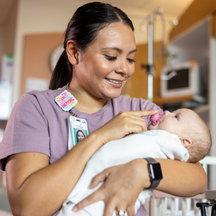
We care for thousands of children each year across our inpatient and outpatient programs. Our model is built on team-based care in its truest form: physicians, nurses, therapists, behavioral health experts, social workers, child life specialists, nutritionists, and facility dogs, all working in concert around the child and family.
This is tertiary rehabilitation: deeply specialized, reserved for the children whose medical complexity means their community simply cannot meet their needs. Our job is unique and special. There’s a science to what we do for our patients. It is not just exercise and play; it has purpose and a goal.
For two decades, the University of Maryland Medical System and Johns Hopkins Medicine have supported us with extraordinary research and leadership that’s made our work so effective. Our combined expertise has made this work possible at a scale and depth none of us could achieve alone.
Here’s to the next 20 years. And here’s to every child still waiting for their landing.