When Alex Hoehn walks into a patient’s room, the equipment she brings is a little different than most health care providers. She relies on her voice and instruments to provide music therapy to babies in Norton Children’s NICU.
New research by Hoehn and her colleagues may enhance the use of music therapy in medical settings.
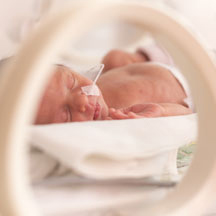
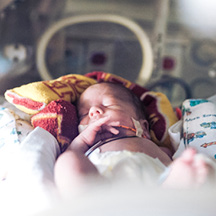
The NICU is a stressful start to life for a premature infant. Music therapy has proven to reduce some of that stress and have medical benefits for babies who receive it.
Hoehn, MT-BC, was part of a research team that examined the results of live lullaby singing to infants born 25-28 weeks gestation during their first week of life. This is some of the first research done with babies that young.
“At 25 weeks, infants can hear everything in their environment,” Hoehn said. “A lot of the noises they hear are stressful — machines beeping, fearful voices, crying. We want them to hear positive noises as well.”
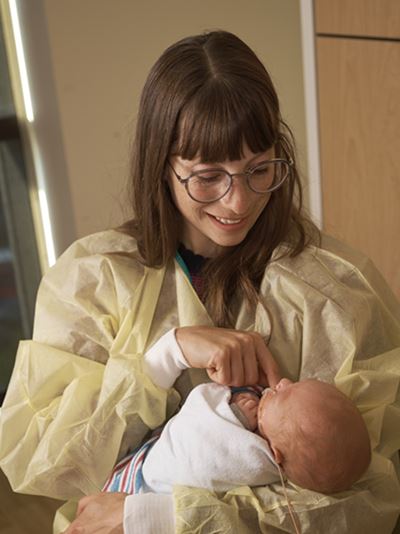
Early results are encouraging. Infants who received music therapy experienced better breathing and blood oxygen levels than those who did not, and they had less severe intraventricular hemorrhages. These babies also left the NICU and went home sooner.
Hoehn hopes this research will lead to music therapists working with parents to sing to their babies. Previous research has shown that music is more beneficial for babies when it is provided by their parents. It may help parents as well.
“When an infant is born really early, parents often feel helpless and sometimes are afraid to interact with them,” Hoehn said. “They can’t hold or even touch their baby much and often have to be quiet at their bedside. But singing is something very natural for parents to do with their baby. We want parents to feel empowered to sing to them, respond to their behavior, and build that connection.”
Encouraging choice during music therapy
Hoehn recently attended the World Congress of Music Therapy, where she connected with colleagues from across the world. She facilitated a discussion about championing children’s preferences, from preemies through teens, in music therapy and how that can increase positive effects of the therapeutic experience.
“Providing opportunities for autonomy and choice is extremely important, especially in a hospital environment where patients don’t often have that,” Hoehn said. “We pay attention to what they gravitate toward and how they react, and that can shape their hospital experience.”
With older children, music therapists can ask their opinions. When Hoehn works with babies, she looks for feedback through their emotional behavior and body language to help guide the music she provides. Listening to these infants has benefits that last beyond the music therapy session.
“One baby I worked with loved the song ‘Baby Beluga,’” Hoehn said. “Anytime I sang it, he would stop crying. If nurses were working with him and he was upset, they would call me to come sing ‘Baby Beluga’ to him. Through music therapy, and especially this song, we were able to calm him down when he was upset and increase his tolerance to different types of stimulation and treatment.”
Music therapy benefits hospitals
Before joining Norton Children’s, Hoehn worked at several other hospitals and has seen the benefits of music therapy every day for years.
Hospitals that provide music therapy see decreased length of patient stays, higher patient satisfaction scores, and more return visits by families.
“Most people know that music is beneficial, but they don’t fully understand it,” Hoehn said. “A lot of the nurses I work with tell me they didn’t realize how much music therapists do and what an impact we have until they see it. We’re a resource that is here to support patients and their families. We have a positive impact on their hospital experience and even on their lives.”